Mogadishu battle of October 3–4, 1993
Black Hawk DownThe Mogadishu battle of October 3–4, 1993, transformed a capture mission into a prolonged urban battle in which soldiers confronted not only armed opposition but also the difficulty of distinguishing combatants from civilians in crowded streets. Its immediate violence and the choices made under fire would become inseparable from the rescue effort, the heavy casualties, and the decision to end the American mission in Somalia.
Escalation and the Collapse of Distinction
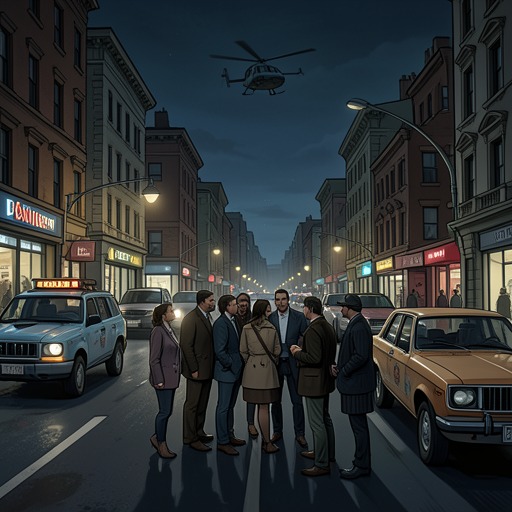
The firefight drew people toward it from across Mogadishu. Surveillance cameras watched crowds build barricades and light tires to summon help, while armed people rushed toward the helicopters marking the fighting. On the ground, Eversmann’s men faced gunmen darting through alleys and crowds farther up Hawlwadig Road. The Rangers’ rules of engagement permitted them to shoot only at someone pointing a weapon at them, but armed people were mixed among women and children. The book describes the crowds as a feature of local responses to disturbances and notes that Ranger missions over the preceding summer had stirred widespread hatred.
That boundary became especially immediate for Eric Spalding’s vehicle as it crossed an alley. A woman in a flowing purple robe ran past with a baby on her arm; Spalding warned the driver not to shoot because she had a child. The woman turned, raised a pistol with her free hand, and Spalding shot her. He fired four more rounds as she fell, then, unable to see what had happened to the infant, feared he had hit the baby too. The episode captures the perilous speed of decisions in the street: the child was visible, but so was the weapon, and there was no time to resolve the uncertainty before firing.
As the fighting and losses accumulated, the restraints described at the outset gave way for some soldiers. On the drive back to base, Dale Sizemore shot young boys whether or not they carried weapons and fired into crowds of women alongside armed men. He was numb, angry, and intent on protecting his friends by doing whatever he could to get them back safely. The shift from a rule focused on an observed threat to indiscriminate fire marks one of the battle’s starkest changes: the same crowded streets that had made restraint difficult became the setting for its abandonment.
A Civilian's View of the Fight
The battle was not experienced only from the Rangers’ side of the streets. Abdikarim had initially stayed inside as shooting spread, but neighbors told him the Rangers had captured Aidid, and he went toward the market to learn what had happened to relatives who lived nearby. The streets offered no clear account: dead men, women, and children lay along the road, while the violence continued around them.
Abdikarim saw an American soldier bleeding from the leg and trying to hide beside the road. When a woman ran into view, the soldier fired in their direction; she was hit but managed to get off the street. A Little Bird helicopter then swept low through an alley, firing as bullets kicked dust past Abdikarim against a stone wall. Once it had passed, armed Somali men ran down the alley toward the corner from which they could shoot at the American. For Abdikarim, the scene made civilian presence, armed resistance, and incoming fire impossible to separate into safe categories: he had come seeking news of family and found himself exposed between opposing forces.
He judged that going out to see the fighting had been a mistake. Abdikarim fled to a friend’s house, where the occupants huddled on the floor; shooting continued throughout the night, and no one slept. The city’s battle therefore extended beyond the immediate clash and rescue attempts: even a resident who withdrew from the streets remained under fire, unable to know when the violence would end.
Fear, Duty, and the Rescue Effort
The battle reached the men waiting at the base first as radio traffic: reports of Cliff Wolcott’s Black Hawk helicopter going down, then of Mike Durant’s, followed by news that the convoy carrying Todd Blackburn had returned with its vehicle riddled by gunfire and Sgt. Dominick Pilla dead. The wounded Blackburn was motionless, with blood around his mouth. For Steve Anderson, who had already been wounded by shrapnel in his legs on an earlier mission, the accumulating reports made the battle feel less like an abstract call to duty than a danger that had already taken friends and could take more. His friend Dale Sizemore was eager to join the rescue; Anderson felt sick with fear and hid his reluctance.
Brad Thomas faced a more direct choice. Pilla had died in Thomas’s lap during the convoy’s return, leaving him soaked in his friend’s blood. Although Thomas had decided to go back into the city, he later told Struecker that he could not do it. Struecker, a model Ranger expected by the watching men to respond by the book, instead spoke to him quietly and acknowledged that he, too, was afraid. He framed courage as acting while afraid and reminded Thomas that going was their job. Thomas walked away, but when the vehicles were about to depart, he had climbed aboard. The exchange showed how unit expectations could press a frightened soldier forward, while the private conversation gave that demand a human measure rather than making fear disappear.
At the crash-site positions, the immediate problem was not simply reaching the wounded but keeping them alive until help could get through. Nearly three hours into the mission, men gathered in a house roughly a block from Wolcott’s wreck, where a makeshift command post and a growing group of wounded had formed. Commanders judged helicopter evacuation too dangerous. By dusk the ground convoy expected at the crash site had not arrived; the men had seen its vehicles pass several blocks away and understood that it was lost and badly mauled. Darkness threatened to remove another advantage: most had left their Night optical devices (NODs) behind, assuming the midday mission would last only an hour, and many had gone without canteens.
The next effort to move men out exposed the cost of decisions made under pressure. Mike Steele ordered Sean Watson to prepare to leave, but Watson challenged the order bluntly. Five wounded men needed evacuation, two of them on litters, and the body of Earl Fillmore, a Commando sergeant first class shot in the head, also had to be carried. Four bearers would be required for each litter, creating conspicuous groups in the open; Watson argued that the defended courtyard was difficult to overrun and that stepping outside would invite bullets and grenades. His objection was not a refusal of the rescue mission but a warning that its proposed method could expose the wounded, the dead, and their rescuers to still greater danger.
The broader relief force faced its own urgent constraints. More than five hours into the battle, Bill David, ground commander of the Quick Reaction Force, was assembling a multinational column of about 150 men in nine flatbed trucks and a dozen Humvees. Wounded Rangers in the city might die without prompt relief, but the convoy had already tried to reach the southern crash site and been forced back at K-4 Circle, more than a mile short, by a heavy ambush. As the night wore on, Mike Steele’s men had been pinned down for more than nine hours; the shooting had largely subsided, but the approaching thunder of the rescue column’s guns was the sound they watched for. The D-boys, meanwhile, had returned early to the hangar and were cleaning weapons, checking equipment, and replenishing ammunition, ready to go back out. Relief was being organized amid exhaustion and uncertainty, not after the danger had passed.
Political Consequences and Commemoration
The battle quickly became a crisis in Washington as well as a fight in Mogadishu. The day after the raid, Secretary of Defense Les Aspin and Secretary of State Warren Christopher faced angry questions from Congress about how American soldiers had come to be dying in Somalia. Bill Clinton, who had not been briefed in advance because the mission had been mounted so quickly, was angry and wanted answers about both policy and military tactics. At a six-hour meeting on October 6, officials confronted the scale of the loss: eighteen American soldiers dead and seventy-three wounded, hundreds of Somalis dead, and Mike Durant still captive. With public outrage mounting and Congress demanding withdrawal, continuing the campaign to capture Mohamed Farrah Aidid was judged politically impossible, despite military assessments that his forces had been badly weakened. The decision was to reinforce Task Force Ranger, end efforts to capture Aidid, and withdraw the force by March 1994.
The toll gave the battle its lasting weight. It was the largest firefight involving American troops since the Vietnam War, with more than 500 Somalis dead and at least 1,000 injured. The immediate objective had been to capture Omar Salad and Mohammed Hassan Awale, men who remained little known after the fighting, while the cost of pursuing that objective reshaped the American mission. President Clinton later accepted Robert Oakley’s appeal on behalf of Somali leaders and ordered the release, several weeks afterward, of every Somali captured by Task Force Ranger. By the end of the month, every American who had fought was home.
The meaning of October 3 remained contested. Many people in Mogadishu commemorate it as Ma-alinti Rangers, or The Day of the Rangers, and regard it as a national victory. The book presents that commemoration against a price borne on both sides, making victory, if either side could claim it, a Pyrrhic one. Colin Powell, who had approved sending Task Force Ranger to Mogadishu, later maintained that the soldiers had done nothing wrong militarily and that they had suffered an unexpectedly bad afternoon; his comparison with the vastly greater weekly American death toll at the height of the Vietnam War also exposed how differently the same number of casualties could be measured. Aidid was killed in factional fighting in 1996, the same day General Garrison retired from the Army, but that later coincidence did not reverse the political consequence already set in motion: the battle effectively ended America’s mission in Somalia.